Amcel research
Redox economic synthesis
The aim of the Amcel research is to improve the sustainability and energy efficiency of chemical synthetic routes by developing new catalytic reactions for desirable transformations in which the use of high-energy reactants is avoided. To achieve this aim, the collective work within Amcel aims at shifting the paradigm of chemical synthesis by coupling catalysis to an additional, renewable energy source, thereby enhancing the sustainability, safety and energy-preservation of chemical synthesis.
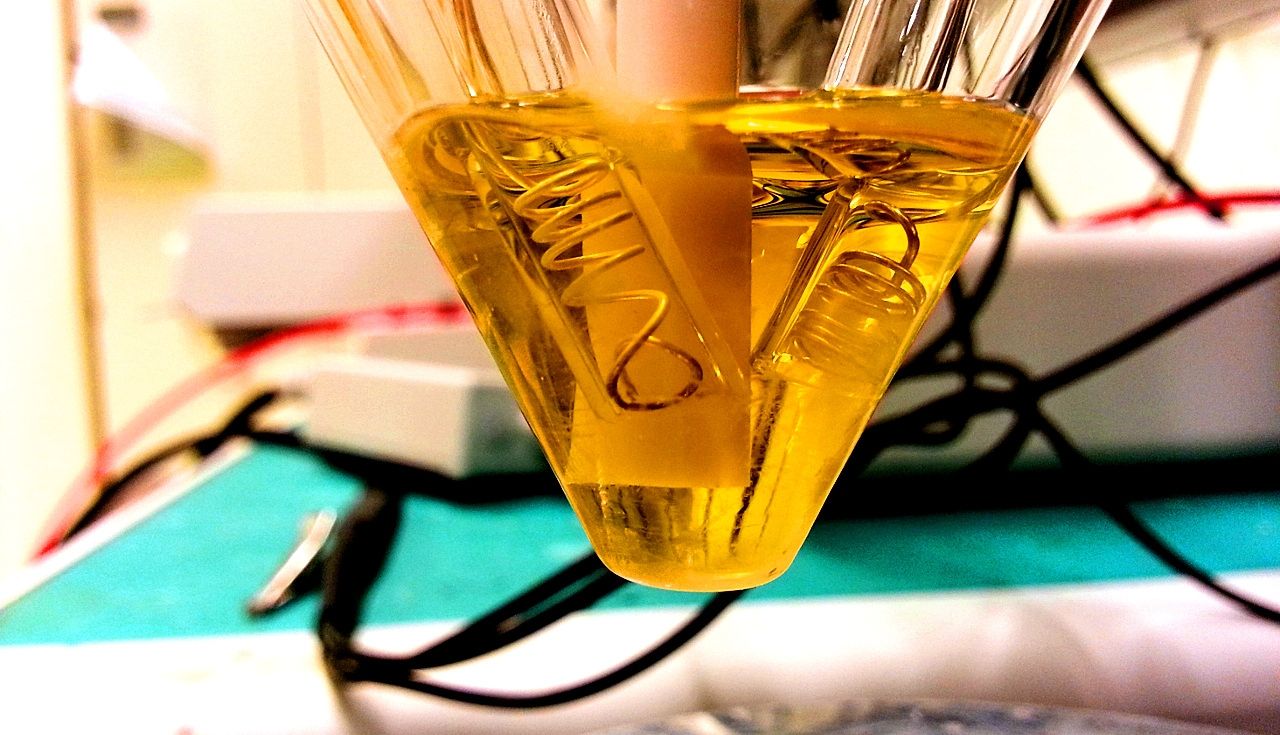
In turn, the coupling of electrochemical synthesis with photochemical energy conversion provides a highly attractive approach to production of (fine) chemicals, that is sustainable in consumption of both energy and feedstocks. Furthermore, coupling electrochemically produced H2 directly with catalytic chemical transformations within one and the same electrolyzer is expected to offer entirely new possibilities to produce products that are otherwise very difficult (energy consuming, inefficient) to prepare.
Amcel aims in particular at improving the redox economy of chemical syntheses and the competitiveness of chemical industries employing these more environmentally friendly methods. This can be achieved with state-of-the art electrosynthetic approaches, by combining catalysis with electrochemistry. As such, it couples selectivity to energy efficiency! Many catalytic approaches can be combined with electrosynthesis, e.g. hydrogenation reactions, carbon-carbon and carbon-element bond formation, or complex skeletal rearrangements, which provide powerful methods to improve the selectivity of challenging transformations, including stereoselectivity as required for advanced pharmaceuticals.
“Redox economy refers to the endeavours to reduce the number of non-strategic (...) or corrective oxidation and reduction steps in synthesis, not only because these steps lower the overall efficiency of a synthesis, but also since many redox reactions are difficult to scale up in industrial settings and are frequently the source of noxious by-products and environmental problems”.Baran & Hoffmann, 2009. Angew. Chem. Int. Ed., 48, 2854.
Amcel Research Topics
It is evident that there is not a single strategy for the implementation of redox economic synthesis through the combination of synthesis, catalysis and electrochemistry. The electrification of the chemical industry has many aspects. The following research areas all carry the potential to establish Amcel as a world player in this field: